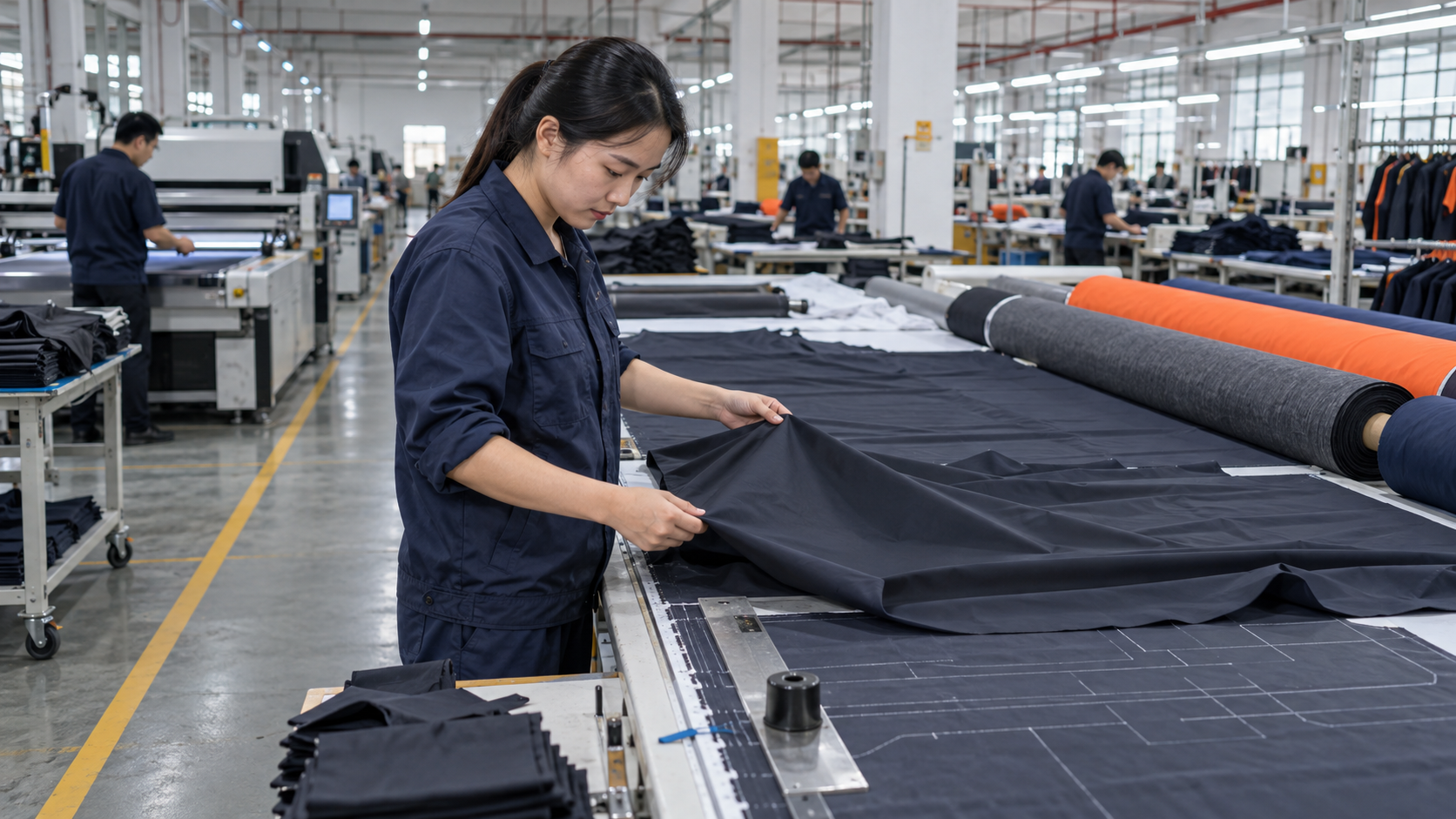
Choosing industrial workwear fabric is not a matter of selecting the heaviest cloth or the lowest unit price. The useful choice is the fabric that supports the work, survives the expected care cycle and remains suitable for the relevant risk assessment. This guide gives procurement teams a practical way to compare options before sampling custom workwear.
1. Start with the work, not a fabric name
A fabric specification becomes useful only when it is tied to a product application. Begin by recording where the garment is worn, whether the work is indoor or outdoor, how much movement is involved, and what could cause the garment to fail. Warehouse teams may value breathability and abrasion resistance around pallet edges. Field service crews may prioritise wind, rain and visible contrast. Maintenance teams may need room for kneeling, tools and frequent industrial laundering.
Ask end users what happens during a long shift. Do sleeves snag? Does heat build up under a jacket? Are pockets overloaded? Does the garment need to dry overnight? These observations are more actionable than a request for “durable fabric” because they tell a supplier where to focus construction, reinforcement and weight. A fabric that feels excellent in a meeting room can become uncomfortable or restrictive after several hours of lifting, driving or climbing.
Separate protective requirements from general workwear expectations. A durable poly-cotton trouser, for example, is not automatically suitable for a flame, chemical or arc-flash hazard. If a specific protective claim is required, establish the destination-market requirements and supporting test documentation before selecting material or making a claim. The employer’s risk assessment remains the starting point for that decision.
- Working environment: temperature, rain, UV exposure, dirt and light conditions.
- Task load: crouching, reaching, tool carrying, vehicle use and repetitive movement.
- Care route: home wash, industrial laundry, replacement frequency and repair policy.
2. Read a fabric specification like a buyer
For ordinary custom workwear, a first specification normally identifies fibre composition, fabric construction, nominal mass per square metre, colour, finish and intended care. Composition influences feel, moisture handling, shrinkage behaviour and dye response. Construction describes how yarns are arranged; it often affects texture, tear behaviour and dimensional stability. Fabric mass is useful for comparison, but it does not tell the whole story about strength, comfort or service life.
A buyer should ask what the quoted value represents and how the supplier controls variation. “Approximately 245 g/m2” is a different statement from a guaranteed finished-garment performance. The same is true of a water-repellent finish: confirm the intended use, the expected care method and whether the requirement is simply initial repellency or a defined performance after laundering. Clear wording protects both parties from treating marketing language as a technical commitment.
Colour also deserves a technical conversation. Deep shades, fluorescent colours and contrast panels can respond differently to light, washing and heat. Request a lab dip or fabric cutting for colour approval when brand consistency matters. For multi-component garments, inspect the colour relationship between main fabric, knit rib, tape, zipper pulls and embroidery thread under normal viewing light before bulk cutting begins.
Factory testing note: retain the approved fabric swatch, colour reference and garment construction sheet with the sealed sample. They create a traceable comparison point during in-line review and shipment inspection.
3. Balance durability, comfort and climate
Durability is usually a system rather than one fabric characteristic. It includes the base material, seam construction, reinforcement at contact points, zipper and fastener quality, fit allowance and the way the garment is washed. A heavier fabric can resist abrasion well, but it may increase heat burden or reduce range of motion. A lighter fabric can improve comfort, but may need a more careful pocket design or reinforcement strategy in high-wear zones.
For warm indoor environments, procurement teams often compare lighter woven fabrics, breathable panel placement and a fit that allows air movement. For cooler or wet environments, the question changes to layering, wind resistance, water management and whether the garment is used as an outer shell or as part of a system. A single all-season garment can be attractive on paper, but a two-layer uniform programme may be more practical when teams work across different climates.
Do not overlook fit. A garment that binds across the shoulder, rises when the wearer reaches overhead or pulls at the knee can be rejected even if the fabric itself is sound. During sample fitting, observe the task rather than only the standing pose. Ask wearers to sit, lift, reach, bend and use the pockets. Record the comments and decide which changes belong to pattern, fabric stretch, panel placement or sizing before the production sample is signed off.
Need a clearer specification?
Turn your requirements into a practical workwear brief.
4. Plan for laundering before placing the order
The care route often determines whether workwear keeps its intended appearance. Home laundry and industrial laundering can differ in temperature, chemistry, tumble drying, load size and mechanical action. If a customer plans to use a commercial laundry, disclose that requirement early. It may influence fabric, trim, logo method, care label and the test method chosen for the programme.
Ask for realistic care instructions, not a generic maximum temperature. A useful instruction explains the intended wash and drying route for the supplied garment. If the garment contains reflective tape, water-repellent finishes, heat-transfer branding or contrasting fabrics, discuss how these elements will be checked after relevant care cycles. A factory test sample can help identify avoidable issues before a large order is packed.
Appearance retention is commercial as well as technical. Teams often need uniforms to look consistent in front of customers, visitors or project stakeholders. Consider colour change, pilling, seam puckering, logo edge lift and shape retention as part of the approval criteria. Document what is acceptable, who approves it and how a concern will be communicated before shipment.
- Confirm the planned laundry route and target care instructions.
- Test the complete garment where trims, branding and tape are involved.
- Keep post-wash observations with the sample approval record.
5. Use sampling to make a decision, not to decorate a presentation
A development sample is most valuable when it answers specific questions. Does the fabric weight suit the climate? Is the pocket accessible with gloves? Does the reflective tape line remain visible when a worker bends? Does the logo placement interfere with a chest pocket? Give the sample a short test plan before it arrives, and involve the people responsible for safety, procurement and end-user acceptance.
Photograph and measure the approved sample. Record the material reference, colour, artwork size, placement, size chart and construction details. A sealed or approved sample is not a legal substitute for every technical requirement, but it is a practical production reference. It helps a factory identify what has been agreed when materials enter cutting, sewing and final inspection.
Before bulk production, convert sample feedback into a final order specification. Avoid changing fabric, colours, logo positions and packing instructions in separate messages without a consolidated confirmation. The more precisely customer requirements are captured in one approved document, the easier it is to compare bulk goods to the agreed standard during shipment inspection.
6. Questions to ask a workwear supplier
A supplier should be able to explain what is known, what requires testing and what depends on the final brief. Useful questions include: Which fabric constructions are suitable for this use? What is the proposed mass and composition? Which garment components are likely to be critical in washing? How will colour and artwork be approved? What checks take place before packing?
Avoid selecting a supplier only from a fabric swatch or catalogue picture. Review the full garment construction, the quality checkpoints and the communication path for changes. In a practical factory visit or remote production review, look for how materials are identified, how cut panels are controlled, where in-line checks happen and how completed garments are separated before packing.
At GarbPact, we use the approved specification and sample as the reference through material preparation, garment construction and final inspection. The correct fabric proposal still depends on the job, garment type, delivery market and care requirements. A concise buyer brief lets the discussion start with evidence rather than assumptions.
Frequently asked questions
What fabric is best for industrial workwear?
There is no universal best fabric. Start with the work environment, movement, laundering route and any required protective performance, then compare complete garment samples against those conditions.
Is a higher GSM always more durable?
No. Fabric mass is one comparison point, not a standalone durability guarantee. Construction, fibre blend, finishing, seam design and the actual task all affect service life.
What should be tested before bulk production?
Test or inspect the complete approved garment for the requirements that matter to the order: fit, colour, workmanship, branding, care response, pocket function and any applicable documented performance.
Conclusion
The best industrial workwear fabric is the one that matches the team’s real conditions and has been approved through a documented sample process. Start with the job, read the specification carefully, plan for care and test the complete garment before bulk production. That approach produces a more useful uniform and a clearer purchasing decision.
Send your intended use, garment type, quantity and care requirements. We will help structure a fabric and sampling discussion around your project.